
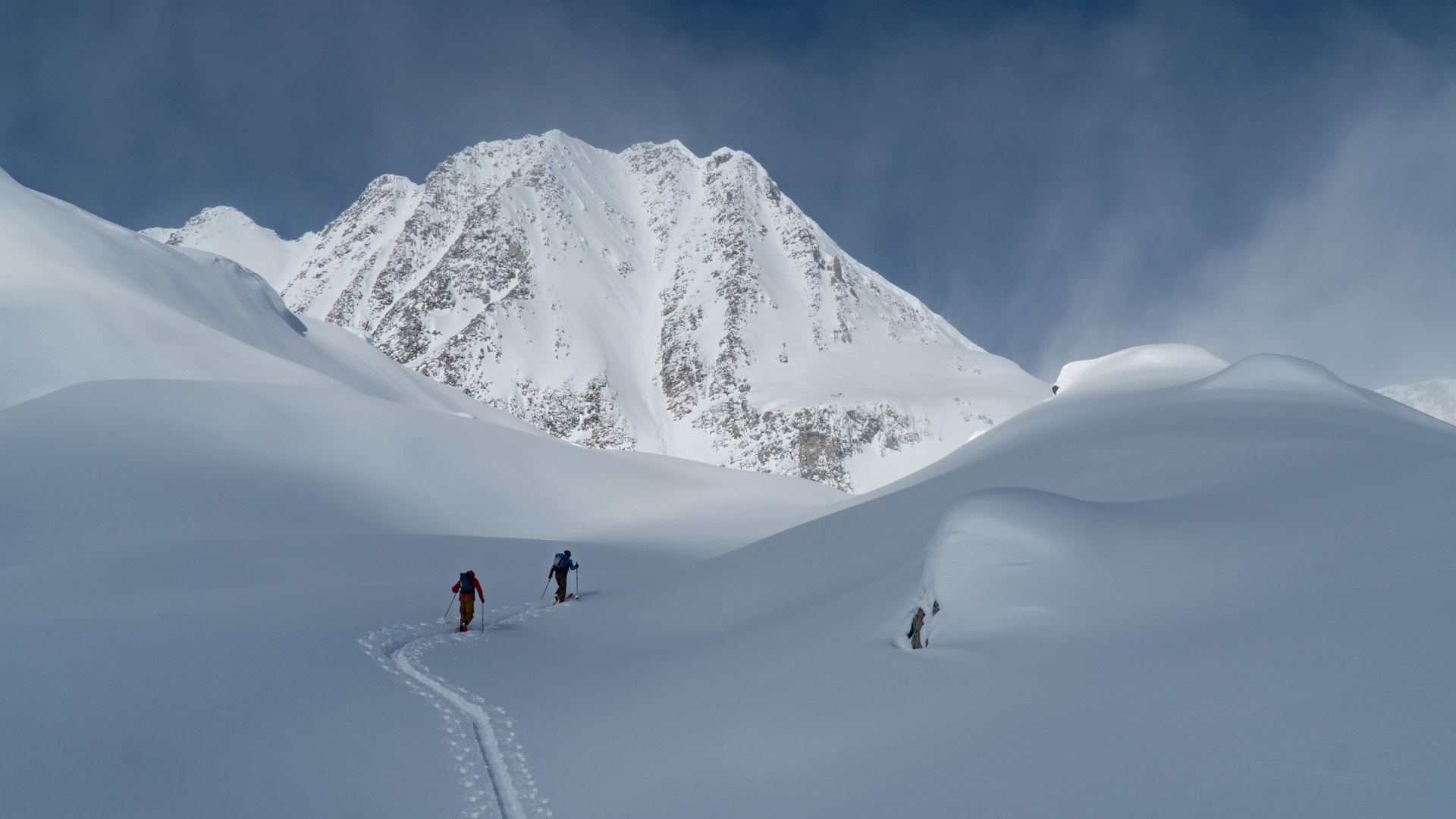
How many times have I realized, halfway to Rogers Pass, that I’d forgotten something critical back in the gear closet? Once, I left my ski boots at home – no joke. I popped the trunk at the trailhead, ready to gear up, and there they weren’t. My heart sank. All I could do was turn around and drive back to Revelstoke. Brutal. That experience – and a few close calls – inspired this post. It’s a detailed guide to help you avoid the same kind of trip-ruining mistakes. I’ll walk you through what to pack for a ski tour (or splitboarding) and highlight some key gear.
Related: Packing For A Backcountry Hut Trip: Tips For A Great Ski Tour
The Ski Touring (Splitboarding) Essentials
Avalanche transceiver, shovel and probe: This is the first thing that I pack. Going in the backcountry without the potentially life-saving avalanche equipment is a big no-no. While the shovel and probe live in my daypack, I usually stuff my avalanche transceiver in my “car” bag (a simple grocery bag) along with my climbing skins, a pre-hydration water bottle and some snacks.
Touring skis, ski boots, poles & skins: They are all bundled together so I don’t forget anything. Make sure your touring skis have workable bindings and ski boots, a selectable walk mode. I prefer two-piece adjustable poles, since they can be shortened when bootpacking and easily strapped to my pack. To avoid cold fingers, pre-mount your climbing skins in the comfort of your home.
Related: How To Choose Touring Skis, Bindings, Boots and Skins
Backpack: A well-fitted, comfortable backpack makes your day fly by. After conducting extensive research over many years, I’ve identified the key features to look for in a backpack suitable for ski touring day trips. I’ve found a 35-40L backpack works best for standard day trips, while a 40-45L pack, for technical ski-mountaineering missions. For a deeper insight into backpack features, check out How To Get Into Ski Touring (Backpacks).
Ski googles: On a wintery day, ski googles are a must when I pack for a ski tour. Bring an appropriate lens for the expected weather. On most days, I carry a low-light lens in the Interior British Columbia as it works for overcast days and skiing in those shady, north-facing bowls. By springtime, I’ll bust out the sunny lens. Nowadays, unless I’m expecting snorkel-deep powder, I wear “visor-like” sunglasses such as the Smith Wildcat with a photochromatic lens and low-light lens. The ski googles stay at home until it’s truly storming out there. Those sunglasses are lighter, more packable and work as well in knee-deep powder as your typical googles.
Skin Wax: On a warm spring day, moist snow will tend to pack under your climbing skins, hampering your glide. Skin wax is essentially a waterproof coating for your skins, making it harder for snow to stick to those prickly hairs. While it reduces grip slightly, having an unimpeded stride is far more important. Pro-tip: apply skin wax across the entire skin base, at the trailhead, before the climbing skin gets saturated with water. I usually leave the wax at home until mid-February when the temperatures soar.

The Clothing
Base layers and socks: It’s hard to forget the base layers when you pack for a ski tour. You’ll hopefully be wearing them. I heavily recommend merino wool base layers. While they dry slower than their synthetic counterpart, they breathe well, wick moisture effectively, and don’t hold on to body odour. Also, I’d avoid driving to the trailhead with your ski sock. Do your best to keep those heavenly foot bags dry until you begin your ski tour. Slipping wet socks into your ski boots at the start of your tour is the absolute worst! You’ll know when you make that mistake.
Midlayer “active” jacket: This midlayer goes under your outer weatherproof shell. Since you’ll often be wearing this jacket on the uphill, it’s best to choose a midlayer that’s lightly insulated, breathable and wind-resistant. Striking the balance between warmth, breathability and wind-resistance involves much trial and error with different brands and models. It depends on how your body manages heat and sweat during high-output exercise.
Uphill and downhill gloves: Why carry two pairs of gloves? For starters, you’ll need a backup pair when the first one eventually wets out. You also want to avoid soaking your downhill gloves in sweat to maintain their insulating property. Since I get clammy hands, my uphill gloves are breathable, quick-drying and dexterous. I also get cold fingers, so my downhill gloves are ultra-warm and relatively water-resistant. As for ideal material, I favour leather treated with a waterproofing wax such as Nikwax. Leather offers a great balance of durability and dexterity.
Puffy jacket and pants: When it’s truly arctic out on your ski tour, you’ll want to pack a large puffy jacket (either synthetic or down). While down tends to pack smaller, synthetic insulation such as PlumaFill (Patagonia) retains heat when wet. Nevertheless, I always carry a light, midlayer puffy jacket. The puffy pants are entirely optional, and whether you get cold legs. I don’t see a need for it unless I’m winter camping in frigid weather.

The Personal Items
Sunglasses: Sport sunglasses with a lens of at least category 3 rating are an important part of the ski touring quiver. You’ll find yourself wearing them on overcast days, as the sunlight gets amplified by the reflective snow surface. As previously mentioned, I favour visor-like sunglasses since they provide optimal coverage for both the ascent and descent and shelter from the wind. On a truly deep day, the googles will come out of my bag.
Sunscreen and lip cream: Even in the dead of winter, the solar radiation can still pierce through the clouds and affect your skin. It’s crucial to apply sunscreen, with a minimum rating of SPF 50, regularly throughout your ski tour. Zinc-oxide paste becomes especially handy during spring ski tours to protect your face, neck and arms from a nasty burn. You’ll always find a small tube of SPF 50 sunscreen at the top of my pack.
Insulated water bottle: With temperatures dipping below -15 °C regularly during our Canadian winter, water will freeze in a bare water bottle, and you’ll be left with nothing to drink. A quality insulated bottle will keep your tea or water warm throughout the day. There’s nothing better than a hot tea in bitterly cold weather. When spring rolls around, my water intake goes through the roof. Instead of my usual 1L, I tend to drink about 1.5-2L of water, especially when the blazing sun is beating down on my neck. I pack a 500mL-1L Nalgene to supplement my 1L insulated mug.
Repair Kit: Slip a repair kit at the bottom of your bag when you pack for a ski tour. While we all want to avoid being stranded in the backcountry, your equipment will fail at some point. That’s where the repair kit comes in handy. A simple collection of zip ties, bailing wire, pole splint, binding screws, pocket screwdriver, ski straps and gorilla tape will get you back to the trailhead.
.

The Group Gear
Some equipment can be shared between your group, which spreads some heavyweight items across your party.
Emergency toboggan: Not many backcountry skiers or splitboarders carry an emergency toboggan. To be fair, they are expensive, and you’re probably never going to use a toboggan. Think again! The reality of ski touring in the high mountains is that a helicopter rescue may be impossible in some locations. You’ll be travelling through complex, unforgiving terrain. The only solution is to drag the injured person using a toboggan to an area where an air rescue works or back to the trailhead.
Emergency shelter: Using the same line of thought, you’ll need an emergency shelter to cover the injured person while waiting for a rescue or to spend the night in the backcountry. Some products, such as the Ski Guides Rescue Tarp by Alpine Threadworks, can double as a toboggan.
Bush saw and fire starter kit: If you’re spending the night in the mountains, you’ll want to make a fire. Staying warm is paramount. A bush saw that doubles as a snow study saw and a fire starter kit will go a long way to keeping you alive in an emergency.

The Ski-Mountaineering Gack
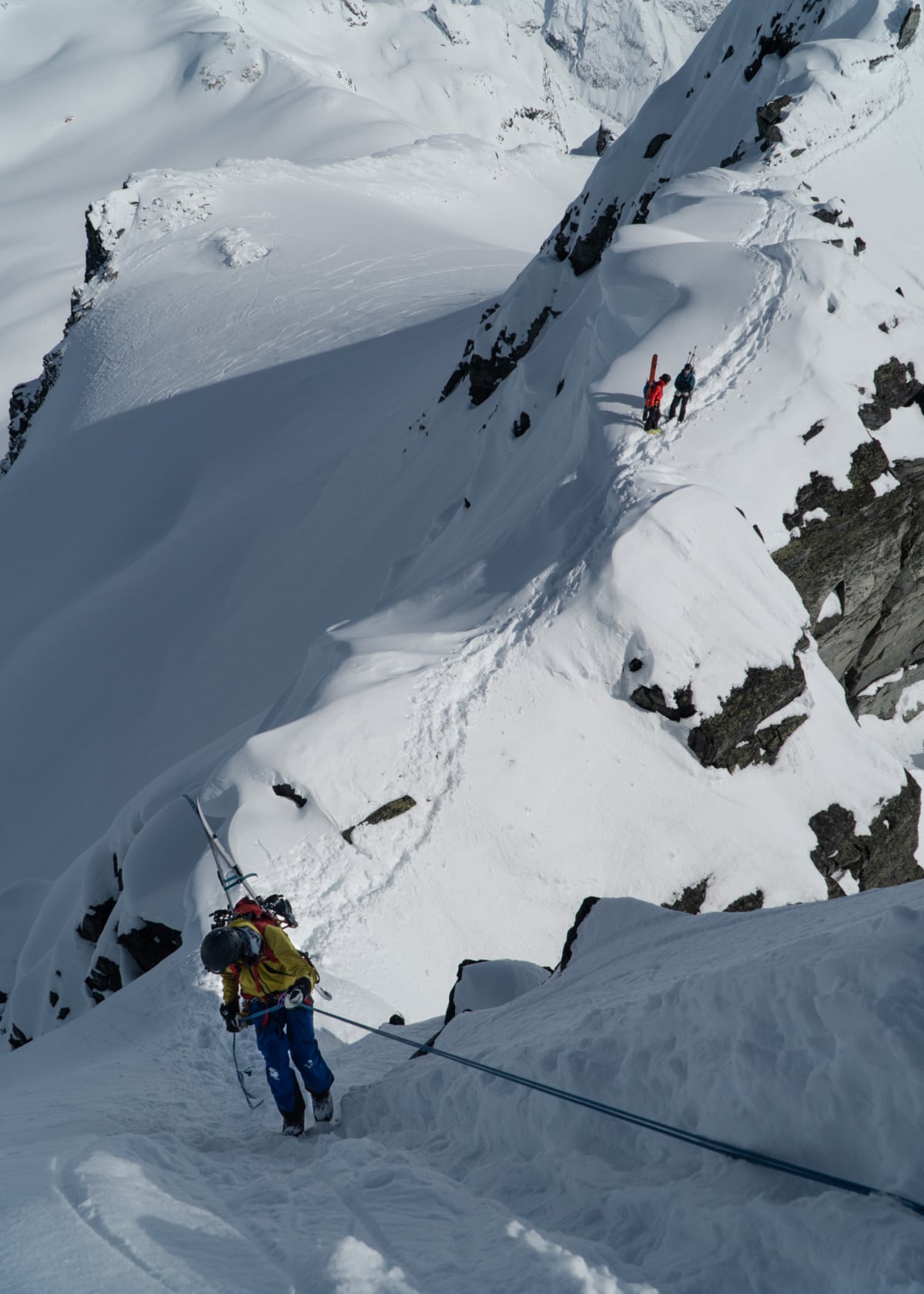
Ski-mountaineering rope: You’ll bring different ropes depending on the objective. Glacier travel, rappels or even lead climbing introduce specific requirements on your rope systems. Gone are the days when you’d have to haul a burly 11mm single rope up a mountain. During most ski-mountaineering trips, I’ll bring a 6mm glacier cord for glacier travel, crevasse rescue, and sometimes rappelling (depending on the complexity of the rappel). If I’m expecting complex scrambling or technical climbing, I’ll bring a lightweight 9mm single rope to belay my partner or short rope.
Glacier harness with gear: While a regular climbing harness works fine, a lightweight ski touring harness will help reduce your pack weight and size. While not the most comfortable if left dangling above a crevasse, the harness will hold your weight. For the most part, you’ll forget you’re wearing it as you slide along the glacier.
Ski crampons: Nobody enjoys wearing ski crampons. They slow down your stride, but they’ll get you out of an uncomfortable situation in a pinch. They are useful – especially in Spring – when you’ll often travel over wind-scoured ridges and refrozen crusts. Verify that the ski crampons are compatible with your bindings and fitted tightly to your skis while moving freely around their pivot. Trust me – too wide of a crampon will ruin your stride – and your day.
Boot crampons: Boot crampons are critical when bootpacking up icy or wind-scoured slopes. While backcountry skiers can often get away with kicking in steps, snowboarders on soft boots are left in the dust. Avoid those heavy steel crampons like the plague. Nowadays, hybrid designs, such as the Pezl Irvis Hybrid, combine the durability of steel front points with the weight savings of aluminum construction and packability of a flexible spine. Some opt for full aluminum boot crampons. Keep in mind that they will wear down quickly when scrambling on rocks.
Related: Spring Ski Touring Gear: The Essential Goes A Long Way
How To Pack Your Backpack
Packing your backpack smartly will get you further up the mountain. It’s crucial for comfort, balance and both uphill and downhill efficiency. In the long run, it’ll help avoid nasty back injuries. Let’s divide the backpack into three sections: the main compartment, top lid, and side pockets (if available).
Main compartment in three layers from bottom to top:
- First aid kit, pocket mask (for CPR), repair kit, rescue toboggan (which doubles as a tarp shelter), and spare accessory cord at the very bottom of my bag. Some would argue that the emergency gear should be stored at the top of your pack. I’ve heavily trained with my emergency gear, and am pretty quick at getting to them. I would rather locate its bulk at the bottom of the pack, right above my hip belt.
- Food, an insulated bottle, and googles in the middle of the main compartment.
- Spare gloves, jackets, and a neck warmer at the top of the main compartment. The lightest items are stored at the top, where there’s the most side-to-side sway.
Top Lid: The top lid houses small, light items such as the sunscreen, granola bars and toilet paper. An emergency satellite communication device, such as a Garmin InReach, also lives in the top lid.
Side & Accessory Pockets: Some bags have side or accessory pockets, perfect to store all the other knick-knacks.
Packing Tips:
- Make sure externally strapped items are secured to your pack so you don’t drop key gear on the uptrack or, even worse, lose it in an avalanche.
- Avalanche safety tools should always be stored internally, ideally in a designated quick-access pocket.
- Store your water bottle in an internal pocket to avoid the water freezing.
- The water hose on Camelback-type hydration systems will freeze in sub-zero temperatures.
- Adjust your pack so that it’s comfortable during your tour.
The Complete Checklist
After all this talk about specific equipment to pack in your bag, I’ve compiled an interactive packing list that you can use every time you go out in the backcountry.
Pingback: Spring Ski Touring Gear: The Essential Goes A Long Way - The Uptrack
Pingback: How To Get Into Ski Touring (Backcountry Skiing) - The Uptrack
Pingback: Packing For A Backcountry Hut Trip: Tips For A Great Ski Tour - The Uptrack